Well-installed hardscape does not need much maintenance — but the little it needs matters. Here is the rhythm we recommend to clients across the Portland metro.
Every season
Sweep and rinse
Organic debris is the main enemy. Leaves, needles and soil left sitting on pavers break down into a thin layer of organic matter that holds moisture and feeds moss and weeds. A regular sweep, plus a rinse, prevents most of it.
In our region, this matters most in autumn, when needle and leaf drop is heaviest, and in late winter, when moss growth peaks.
Check the joints
Joint sand is structural, not cosmetic. It is what transfers load between units and keeps the field interlocked. If you can see open joints or the sand level has dropped noticeably below the paver chamfer, it is time to top up — polymeric sand for most applications.
Twice a year
Look at your drainage
Walk the property during a real Portland downpour, not on a dry day. You are looking for:
- Water pooling on the surface instead of running off
- Water running toward the house rather than away
- Saturated ground at the base of a retaining wall
- Downspouts discharging directly onto hardscape
Drainage problems are the root cause of most hardscape failures we are called to repair. Catching them early is dramatically cheaper than rebuilding.
Inspect retaining walls
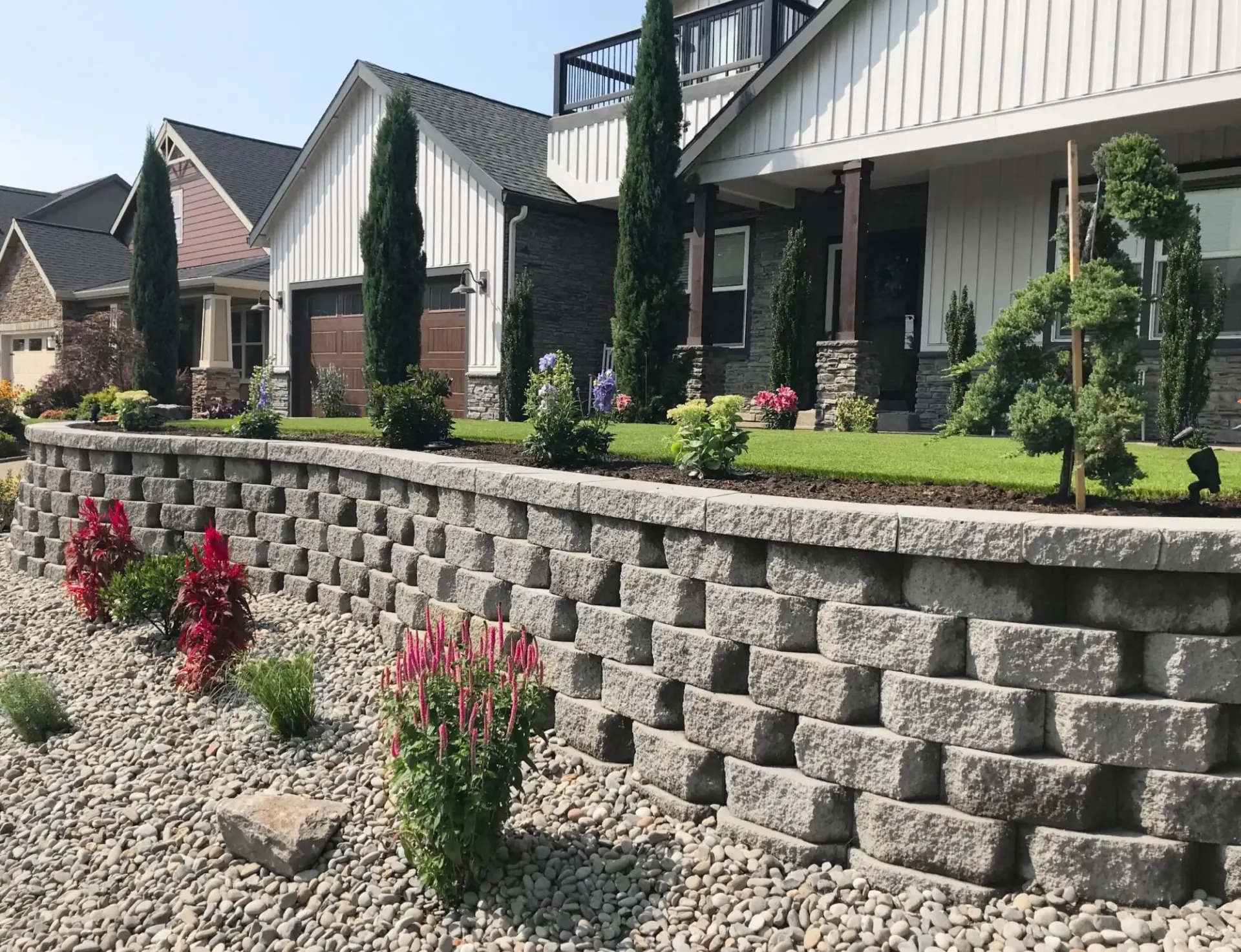
Look along the wall for bulging, leaning, or separation at the joints. A wall that is starting to move gives you warning signs long before it fails. Clogged drainage behind a wall is the usual culprit — hydrostatic pressure is what pushes walls over.
Once a year
Deep clean
A thorough cleaning lifts the accumulated grime and moss that seasonal rinsing does not.
Important — this is where warranties get voided. Pressure washing done incorrectly will blast the joint sand out and etch the paver surface. If you pressure wash:
- Use a wide fan tip, never a turbo or pencil tip
- Keep the wand well back from the surface
- Work at a consistent distance and angle
- Plan to re-sand the joints afterward
If that sounds like more risk than you want, this is worth handing to a professional. Our warranty specifically excludes damage from incorrect pressure washing.
Consider sealing
Sealing is optional. It deepens color, adds stain resistance and makes cleaning easier, but it needs redoing every few years and it changes the finish. It is a preference, not a requirement.
What to avoid
- De-icing salts. Avoid on new installations especially. Use sand for traction instead.
- Turbo-tip pressure washing. See above.
- Letting planting beds spill onto paving. Soil migrating over the edge is how weeds establish in joints.
- Ignoring a small settle. A small settled area is an easy lift-and-relevel. Left alone, it collects water and grows.
When to call someone
Call if you see a wall leaning or bulging, a settled area that keeps growing, water pooling that was not there before, or joints that will not hold sand. All of those are symptoms of something happening below the surface.
We offer repairs and maintenance at discounted rates for existing and previous clients — and we are happy to look at work installed by someone else.